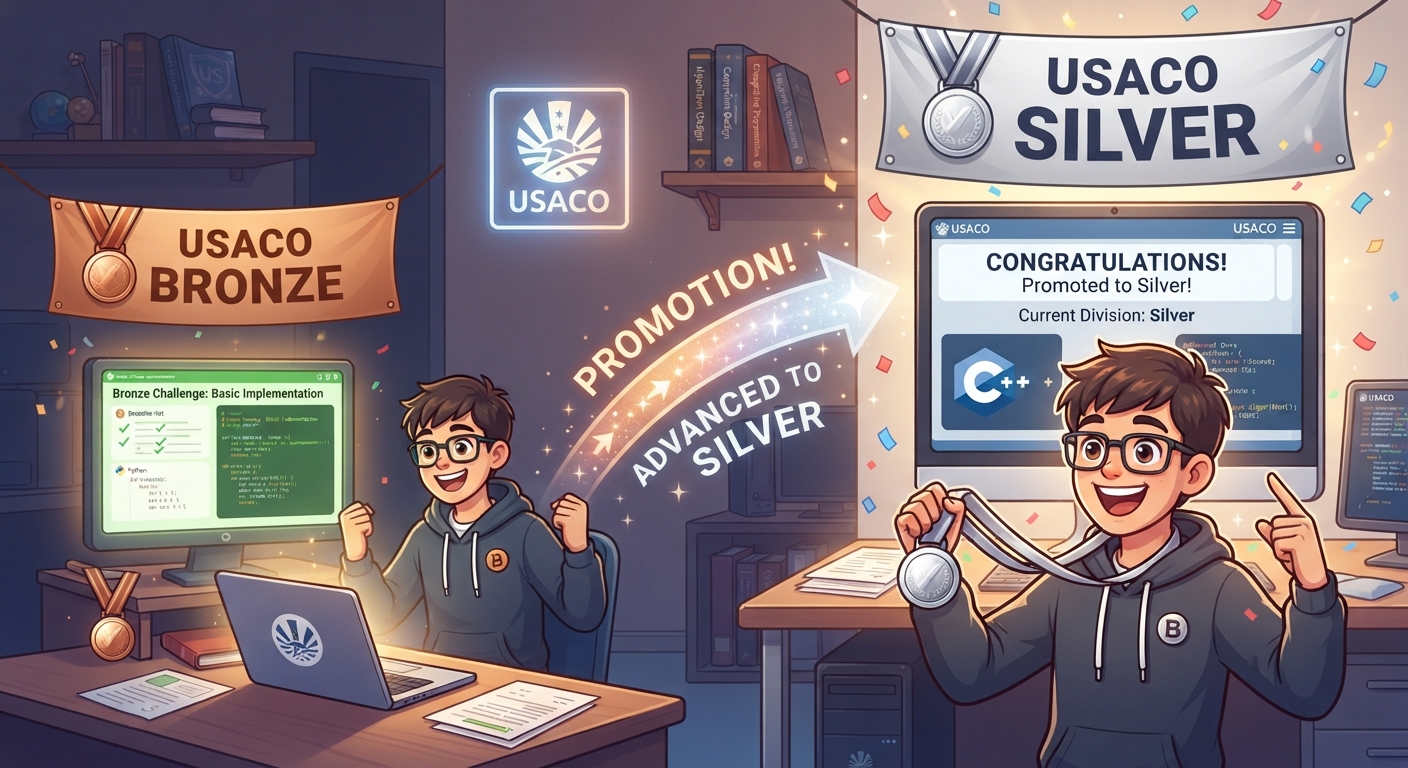
USACO Bronze To Silver Accelerator – Advanced Algorithms & Problem Solving (Part 2 / Semester 2)

Course Overview
Welcome to USACO Bronze Accelerator – Advanced Algorithms & Problem Solving (Part 2 / Semester 2).
This is the second semester of our year-long USACO Bronze Accelerator program.
Part 1 and Part 2 together form one complete curriculum. Part 1 establishes the core problem-solving techniques needed for USACO Bronze. Part 2 builds on that foundation with harder problems, more advanced techniques, optimization, and greater emphasis on independent problem solving.
The program is intentionally divided into two semesters so students can build their skills progressively rather than being overwhelmed by a large collection of algorithms all at once.
Algorithms are tools. Problem solving is the goal.
In Part 2, students continue to follow the Comrite problem-solving process:
Understand → Start Simple → Find the Bottleneck → Learn the Right Technique → Solve → Test → Generalize
The goal is not simply to learn more algorithms. Students learn to recognize which tools are useful, understand why they work, and apply them to unfamiliar problems.
🧠 From Knowing Algorithms to Solving Problems
As students progress through Bronze, the challenge changes.
It is no longer enough to ask:
“Do I know this algorithm?”
Students learn to ask:
“What is this problem really asking, and what approach will work?”
Part 2 places greater emphasis on:
-
Recognizing patterns in unfamiliar problems
-
Comparing simple and optimized approaches
-
Using constraints to guide solution choices
-
Identifying bottlenecks
-
Selecting appropriate algorithms and data structures
-
Explaining why a solution works
-
Testing edge cases
-
Improving solutions independently
Make Every Hour of Practice Count
Competitive programming requires practice, but more hours do not automatically produce better results.
Comrite focuses on making practice purposeful:
-
Prioritize high-value techniques
-
Learn algorithms through actual problems
-
Avoid unnecessary algorithm memorization
-
Use hints strategically when students are stuck
-
Analyze failed approaches instead of simply looking at answers
-
Gradually move students toward independent problem solving
Our goal is not to maximize homework hours. It is to maximize learning and problem-solving progress from each hour of practice.
Complete Curriculum
Across Part 1 and Part 2, students develop skills in:
-
Simulation – Modeling and simulating problems step by step
-
Search & Brute Force – Systematic enumeration and search strategies
-
Recursion – Breaking problems into smaller subproblems
-
Sorting – Sorting techniques, custom comparisons, and applications
-
Graph Basics – Graph representation and fundamental traversal
-
Greedy Algorithms – Recognizing and applying effective local choices
-
Geometry – Coordinates, grids, distance calculations, and geometric reasoning
-
Sets & Maps – Efficient storage, lookup, counting, and frequency tracking
-
Ad Hoc Problem Solving – Reasoning through problems without a single standard algorithm
-
Debugging & Edge Cases – Finding logical errors and handling corner cases
-
Complexity & Optimization – Using constraints to identify inefficient approaches and improve them
Part 2 places greater emphasis on combining these ideas and deciding which technique is appropriate for a particular problem.
What Makes Part 2 Different?
🔍 Problem First, Algorithm Second
Students don't begin every problem by asking which algorithm they should memorize.
Instead:
Understand the problem → Try a simple approach → Identify the limitation → Improve it
This helps students develop algorithm recognition, rather than simply accumulating algorithms.
🧩 Harder Problems, Deeper Reasoning
Students work with more challenging Bronze-level problems that require multiple steps, careful reasoning, and combinations of techniques.
⚡ Optimization Through Constraints
Students learn to use problem constraints as clues.
For example:
How large can N be?
becomes an important question when deciding whether a solution is fast enough.
Students learn to connect constraints → complexity → algorithm choice.
💡 Independent Problem Solving
As the course progresses, instructor guidance gradually decreases.
Students are encouraged to develop their own approach before receiving hints or walkthroughs.
The goal is to move from:
“I need someone to show me the solution.”
toward:
“I can figure out how to approach this myself.”
Course Features
-
Real USACO Problems: Practice with authentic USACO Bronze problems.
-
Advanced Problem Solving: Focus on recognizing patterns, selecting techniques, and combining ideas.
-
Hands-on Practice: Weekly coding exercises and progressively harder challenges.
-
Guided Walkthroughs: Learn how to move from problem analysis to a working and efficient solution.
-
Hint-Based Support: Receive guidance without immediately being given the complete answer.
-
Instructor Feedback: Q&A, code reviews, debugging, and solution discussions.
-
AI-Assisted Learning: Use the Comrite AI Tutor for additional explanations, debugging, and practice support.
-
Flexible Learning: Recorded lessons, notes, and complete solution walkthroughs.
Ideal For
-
Students who have completed USACO Bronze Accelerator Part 1
-
Students with equivalent competitive-programming knowledge
-
Students who have solved easier Bronze problems and want to tackle harder ones
-
Students preparing for USACO Bronze
-
Students who want to become more independent problem solvers
-
Students beginning to develop the skills needed for the transition from Bronze toward Silver
Duration
-
12–16 weeks
-
1 session per week
-
Approximately 1–2 hours per session
-
Part 2 / Semester 2
The course is designed as the continuation of Part 1, not as a separate standalone collection of advanced algorithms.
Prerequisites
Students should be comfortable with:
-
Basic C++, Java, or Python
-
Variables, loops, functions, arrays, and strings
-
Basic STL/data structures
-
Sorting and basic search
-
Basic competitive-programming problem solving
Completion of Part 1 is recommended.
C++ is recommended for students following the traditional USACO pathway.
Materials Included
-
Video lessons
-
Annotated USACO problem walkthroughs
-
Weekly practice and challenge problems
-
Code examples and solutions
-
Instructor hints and feedback
-
AI Tutor at coding.comrite.com
Outcome
By completing Part 1 and Part 2, students will have covered the complete USACO Bronze Accelerator curriculum and developed the ability to approach a broad range of USACO Bronze problems more independently.
Students will be able to:
-
Analyze unfamiliar Bronze-level problems
-
Start with simple solutions before optimizing
-
Use constraints to evaluate solution efficiency
-
Recognize common problem-solving patterns
-
Select appropriate algorithms and data structures
-
Combine multiple techniques when needed
-
Debug and test solutions systematically
-
Explain why a solution works
-
Develop greater independence when facing unfamiliar problems
The ultimate goal is not simply to finish a list of algorithms.
Students learn how to recognize problems, choose the right tools, and solve them.
🚀 Building Toward Silver
Part 2 also begins developing the habits students will need at the next level:
Problem Understanding → Algorithm Recognition → Optimization → Independent Problem Solving
Students who continue to higher-level training can build on this foundation as they transition from USACO Bronze toward Silver.
Part 1 builds the core. Part 2 pushes students further. Together, they form the complete USACO Bronze Accelerator program.
Note: This curriculum includes both Part 1 and Part 2 content
Want to submit a review? Login